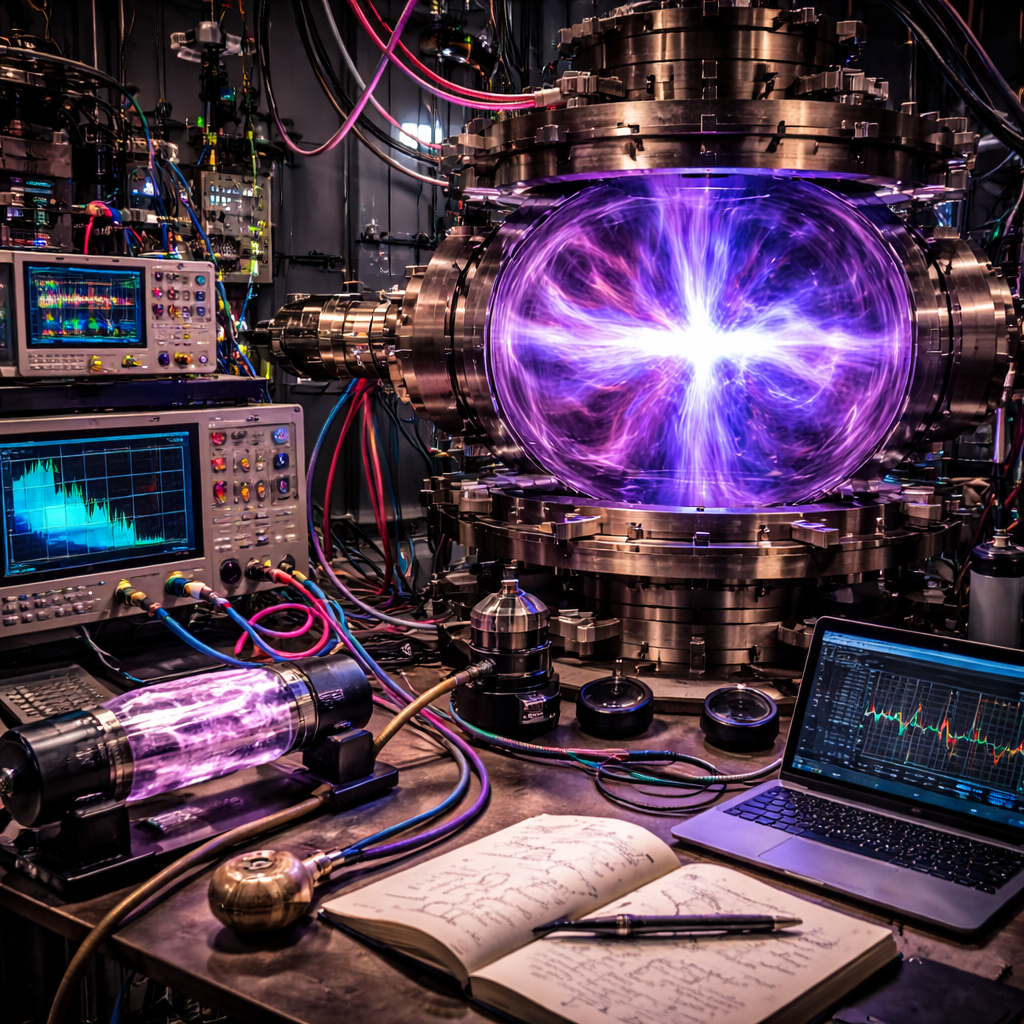
Plasma Physics, within Applied Physics (and broadly within Physics in the Natural & Formal Sciences), is the discipline devoted to the study of plasmas—the ionized states of matter in which charged particles, electromagnetic fields, and collective interactions dominate system behavior. Plasmas constitute more than 99% of the visible universe and appear in environments ranging from stellar interiors and magnetospheres to laboratory discharges, fusion devices, and industrial processing systems. Plasma Physics examines how electric and magnetic fields govern particle motion, wave propagation, instabilities, transport phenomena, and nonlinear collective dynamics. Core areas include kinetic theory and the Vlasov–Maxwell framework, magnetohydrodynamics (MHD), plasma waves and turbulence, confinement and stability in fusion plasmas, sheath formation, collisional and collisionless processes, and plasma–material interactions. Experimental and applied subfields explore magnetic and inertial confinement fusion, space and astrophysical plasmas, low-temperature plasmas used in manufacturing and environmental systems, and high-energy-density plasmas relevant to advanced materials and particle acceleration. Plasma Physics relies on theory, laboratory experimentation, high-performance simulation, and diagnostic technologies such as interferometry, spectroscopy, Langmuir probes, Thomson scattering, and magnetic-field mapping. Its insights are central to fusion energy development, astrophysics, propulsion technologies, industrial plasma processing, and advanced instrumentation.
Within the methodological architecture of the Quantum Dictionary, Plasma Physics represents a domain in which terminology is highly contextual, shaped by plasma regime (thermal, nonthermal, magnetized, relativistic), characteristic scales, confinement geometry, and theoretical or computational model. Concepts such as “confinement,” “instability,” “diffusion,” “sheath,” or “turbulence” collapse into distinct semantic states depending on whether they apply to magnetically confined tokamak plasmas, collisionless space plasmas, low-pressure glow discharges, laser-driven inertial-confinement plasmas, or astrophysical jets. Even foundational terms like “Debye length,” “quasineutrality,” or “transport” acquire altered meaning across kinetic, fluid, and hybrid modeling approaches. Diagnostic context also modifies terminology: “temperature” may refer to Maxwellian fits in laboratory plasmas, anisotropic temperature tensors in space environments, or effective temperatures in nonthermal distributions. Computational frameworks - particle-in-cell methods, gyrokinetic simulations, MHD solvers, or radiation–hydrodynamics codes - introduce further layers related to approximations, closure schemes, and numerical stability. The quantum-semantic architecture encodes each plasma-physics concept as a contextual semantic entity whose meaning resolves according to physical regime, theoretical framework, diagnostic technique, or technological application. This ensures semantic interoperability with adjacent fields such as astrophysics, materials science, fusion engineering, laser physics, and applied electromagnetics, while preserving the definitional precision essential for modeling, stability analysis, and experimental interpretation. By modeling the interplay among charged-particle dynamics, collective phenomena, electromagnetic structure, and multi-scale physics, the Quantum Dictionary provides a coherent and adaptive lexicon aligned with the complex, nonlinear, and technologically pivotal nature of Plasma Physics.