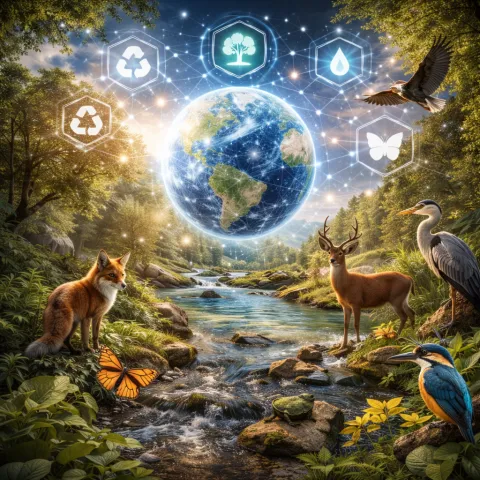
Environmental Science, within Earth & Environmental Sciences, is an interdisciplinary domain devoted to understanding the physical, chemical, biological, and socio-ecological processes that govern the functioning of natural systems and the impacts of human activities upon them. It encompasses Conservation Biology, Ecology, and Environmental Management, integrating insights from atmospheric science, geology, hydrology, chemistry, and biology to assess environmental change, ecosystem health, resource dynamics, and sustainability challenges. Core areas include ecosystem structure and function, biogeochemical cycling, habitat dynamics, biodiversity patterns, pollution pathways, land-use interactions, and climate–ecosystem feedbacks. Environmental Science employs field observation, laboratory experimentation, remote sensing, environmental modeling, and statistical analysis to examine issues such as habitat fragmentation, invasive species, pollution, climate impacts, and natural-resource use. As a policy-relevant scientific discipline, it underpins environmental assessment, conservation planning, regulatory frameworks, and global sustainability initiatives by offering integrative understanding of how natural systems respond to anthropogenic and natural drivers.
Within the methodological architecture of the Quantum Dictionary, Environmental Science represents a domain in which terminology is highly contextual and shaped by ecological scale, methodological approach, regulatory environment, and socio-environmental objective. Concepts such as “resilience,” “impact,” “stability,” “ecosystem function,” or “risk” collapse into distinct semantic states depending on whether they are applied in ecological modeling, conservation planning, environmental-impact assessment, climate-adaptation analysis, or resource-management frameworks. Terminological variation also arises from cross-disciplinary integration - biological, chemical, geological, hydrological, and socio-economic perspectives each infuse environmental terms with different operational meanings. The quantum-semantic architecture encodes each term as a contextual semantic entity whose meaning resolves according to ecological scale (organismal, community, landscape, global), methodological tool (e.g., GIS, remote sensing, ecological sampling), temporal domain (short-term dynamics vs. long-term change), or policy framework. This ensures semantic interoperability with adjacent disciplines - including ecology, atmospheric sciences, hydrology, environmental chemistry, geography, and political science - while preserving the definitional precision essential for environmental modeling, regulatory analysis, and conservation practice. By modeling the interplay among natural processes, anthropogenic pressures, technological systems, and governance structures, the Quantum Dictionary provides a coherent and adaptive lexicon aligned with the integrative, interdisciplinary, and societally consequential nature of Environmental Science.