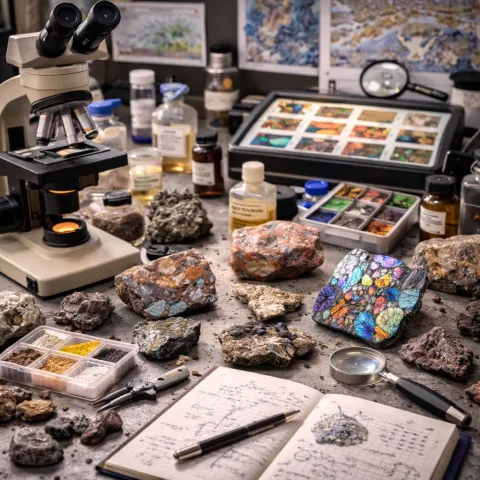
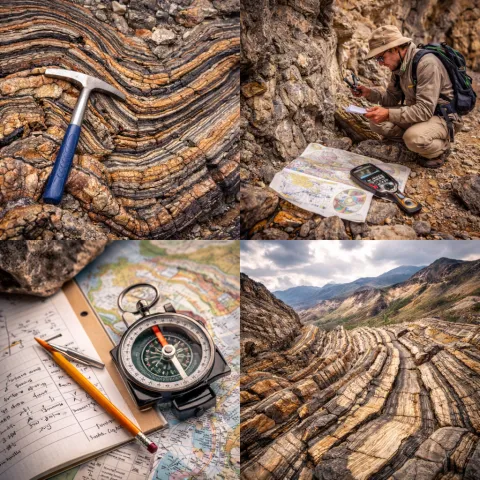
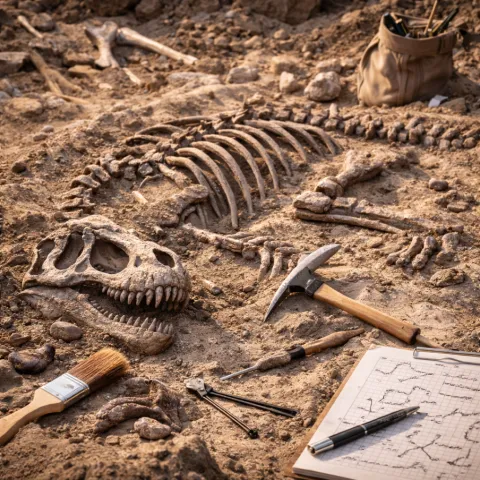
Geology, within Earth & Environmental Sciences, is the foundational discipline that investigates the solid Earth - its materials, structure, processes, and deep-time history. It encompasses the study of minerals, rocks, and geologic formations; the mechanisms that drive plate tectonics; and the forces responsible for shaping Earth’s crust through volcanism, mountain building, sedimentation, metamorphism, and erosion. Geology integrates subfields such as Mineralogy, Paleontology, Petrology, and Structural Geology, each contributing essential insight into Earth’s composition, evolutionary history, and dynamic behavior. Mineralogy examines the chemical and crystallographic properties of minerals, Petrology analyzes the origin and transformation of igneous, sedimentary, and metamorphic rocks, Structural Geology investigates stress, deformation, and tectonic structures, and Paleontology studies fossils to reconstruct ancient life and environmental conditions. Geology relies on field mapping, laboratory analysis, geophysical imaging, and geochemical techniques to interpret Earth processes across spatial scales—from microscopic mineral structures to global tectonic systems—and temporal scales spanning billions of years. As a central earth science, Geology informs natural-resource assessment, natural-hazard evaluation, environmental remediation, planetary science, and the reconstruction of Earth’s climatic and biological past.
Within the methodological framework of the Quantum Dictionary, Geology represents a domain in which terminology is inherently contextual, shaped by temporal scale, rock type, tectonic regime, analytical method, and interpretive paradigm. Concepts such as “formation,” “structure,” “stress,” “facies,” or “metamorphism” collapse into distinct semantic states depending on whether they are invoked in sedimentology, structural analysis, mineralogy, metamorphic petrology, or paleogeographic reconstruction. Terminological meaning also varies with observational modality - field mapping, thin-section petrography, geochemical assays, remote sensing, or geophysical imaging - and with theoretical frameworks such as plate tectonics, basin analysis, or evolutionary paleoecology. The quantum-semantic architecture encodes each geological term as a contextual semantic entity whose meaning resolves according to geological timescale, environmental setting, methodological approach, or structural or depositional context. This ensures semantic interoperability with adjacent disciplines including geography, climatology, hydrology, ecology, and environmental science, while preserving the definitional precision required for geological mapping, hazard assessment, resource exploration, and scientific interpretation. By modeling the interplay among Earth materials, dynamic processes, environmental transitions, and deep-time evolution, the Quantum Dictionary provides a coherent and adaptive lexicon aligned with the integrative, process-driven, and historically grounded nature of Geology.