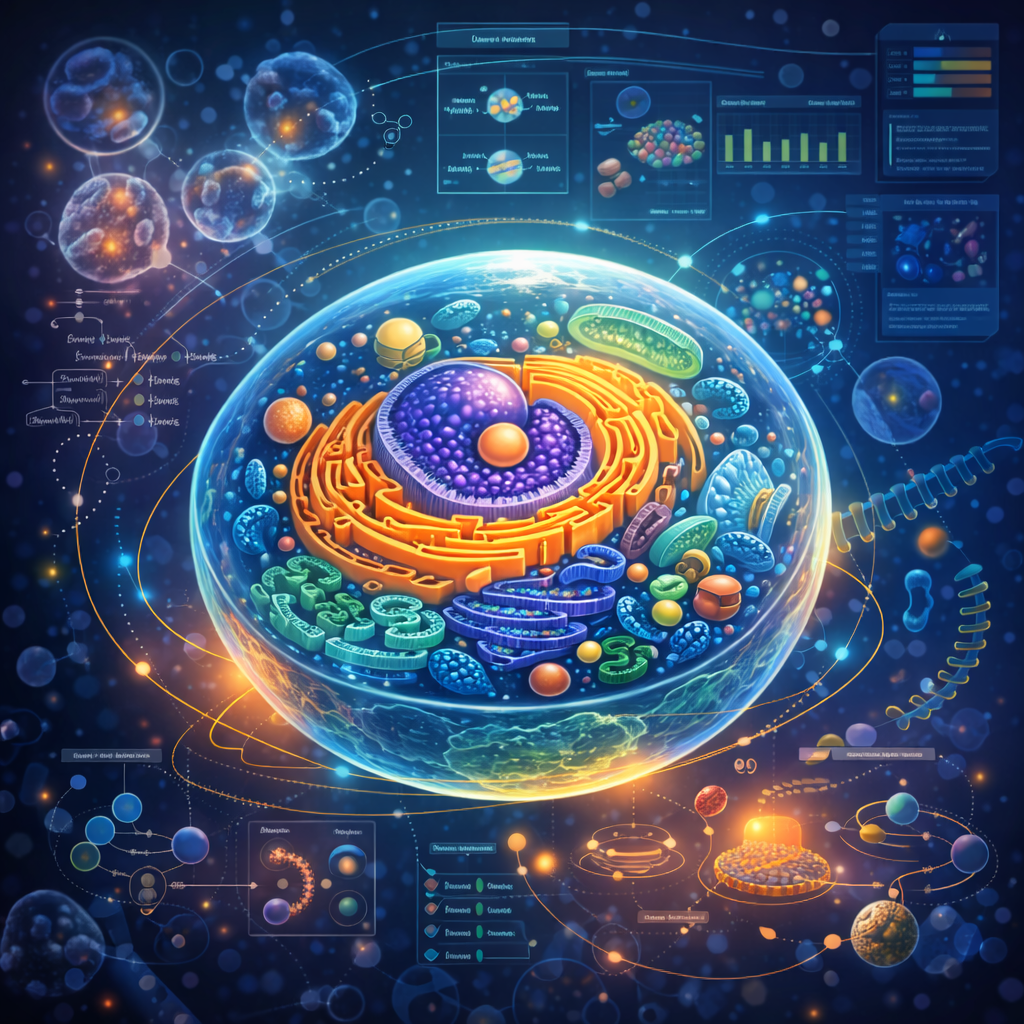
Cell Biology, positioned within General Biology, focuses on the structure, function, organization, and regulation of cells = the fundamental units of life. This discipline investigates the molecular architecture and physiological processes that enable cellular growth, metabolism, communication, division, and differentiation. Core areas include membrane dynamics, organelle function, cytoskeletal organization, signal transduction, gene expression, intracellular trafficking, and cell-cycle control. Cell Biology also explores cellular responses to environmental stimuli, mechanisms of cellular homeostasis, and the pathways underlying apoptosis, senescence, and developmental processes. Through microscopy, biochemical analysis, molecular techniques, and computational modeling, the field elucidates principles that apply to all living organisms, from unicellular microbes to complex multicellular systems. As a foundational biological science, Cell Biology informs and supports specialized disciplines such as molecular biology, genetics, developmental biology, physiology, immunology, and biomedical research.
Within the methodological architecture of the Quantum Dictionary, Cell Biology represents a domain in which terminology varies according to molecular scale, experimental context, and theoretical framework. Terms such as “signal,” “division,” “expression,” “pathway,” or “regulation” collapse into distinct semantic states when used in biochemical assays, genetic studies, imaging analyses, or systems-biology models. Conceptual meanings shift further when applied to prokaryotic versus eukaryotic cells, differentiated tissues versus stem cells, or normal versus pathological states. The platform’s quantum-semantic framework encodes each term as a contextual semantic entity whose meaning resolves according to biological scale, methodological technique, physiological condition, or interpretive model. This ensures interoperability with adjacent fields - including molecular biology, genetics, biochemistry, physiology, and medical sciences - while preserving the rigor necessary for research, diagnostics, and theoretical analysis. By modeling the dynamic interplay among cellular structures, molecular mechanisms, and functional outcomes, the Quantum Dictionary provides a coherent and adaptive lexicon aligned with the complexity and centrality of Cell Biology.