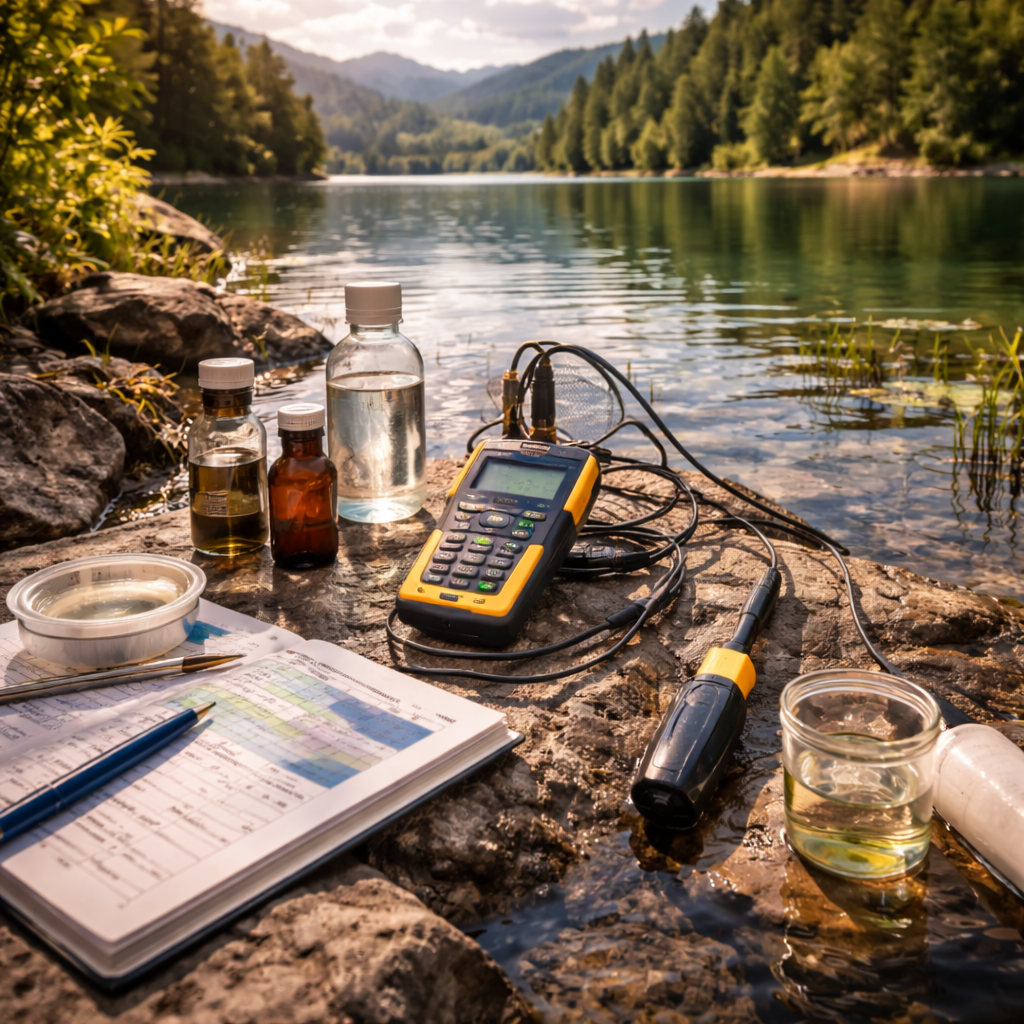
Limnology, within Ocean & Hydrology of the Earth & Environmental Sciences, is the discipline devoted to the study of inland aquatic ecosystems - lakes, reservoirs, rivers, streams, wetlands, and freshwater basins. It encompasses the physical, chemical, biological, and ecological processes that govern freshwater environments, examining water-column structure, nutrient dynamics, sediment interactions, primary productivity, trophic relationships, and biogeochemical cycling. Core areas include physical limnology (thermal stratification, mixing regimes, hydrodynamics), chemical limnology (water chemistry, nutrient fluxes, dissolved gases), and biological limnology (phytoplankton, zooplankton, benthic organisms, microbial communities, and aquatic vegetation). Limnology also investigates watershed influences, pollutant pathways, eutrophication, invasive species, and climate-driven changes in freshwater systems. Methodological approaches incorporate field sampling, water-quality monitoring, remote sensing, ecological modeling, sediment-core analysis, and experimental mesocosms. As a science central to freshwater resource management, Limnology supports applications in drinking-water supply, fisheries management, wetland conservation, ecosystem restoration, and environmental-impact assessment.
Within the methodological framework of the Quantum Dictionary, Limnology represents a domain where terminology is highly contextual, shaped by ecological scale, basin morphology, hydrodynamic regime, and methodological approach. Concepts such as “stratification,” “productivity,” “load,” “clarity,” or “residence time” collapse into distinct semantic states depending on whether they are applied in lake-mixing analysis, nutrient-budget modeling, riverine transport studies, eutrophication assessment, or wetland biogeochemistry. Terminological nuance further emerges from temporal variation - seasonal turnover, episodic disturbances, long-term ecological shifts - and from differing methodological tools such as in situ sensing, hydroacoustic measurement, remote-sensing reflectance, or ecological network modeling. The quantum-semantic architecture encodes each limnological term as a contextual semantic entity whose meaning resolves according to waterbody type, hydrologic forcing, ecological dynamics, or analytical framework. This ensures semantic interoperability with adjacent fields including hydrology, ecology, biogeochemistry, environmental chemistry, conservation biology, and environmental management while preserving definitional precision essential for assessing ecosystem function, water quality, and environmental change. By modeling the interplay among physical processes, nutrient dynamics, biological communities, and watershed influences, the Quantum Dictionary provides a coherent and adaptive lexicon aligned with the integrative, process-driven, and environmentally critical nature of Limnology.