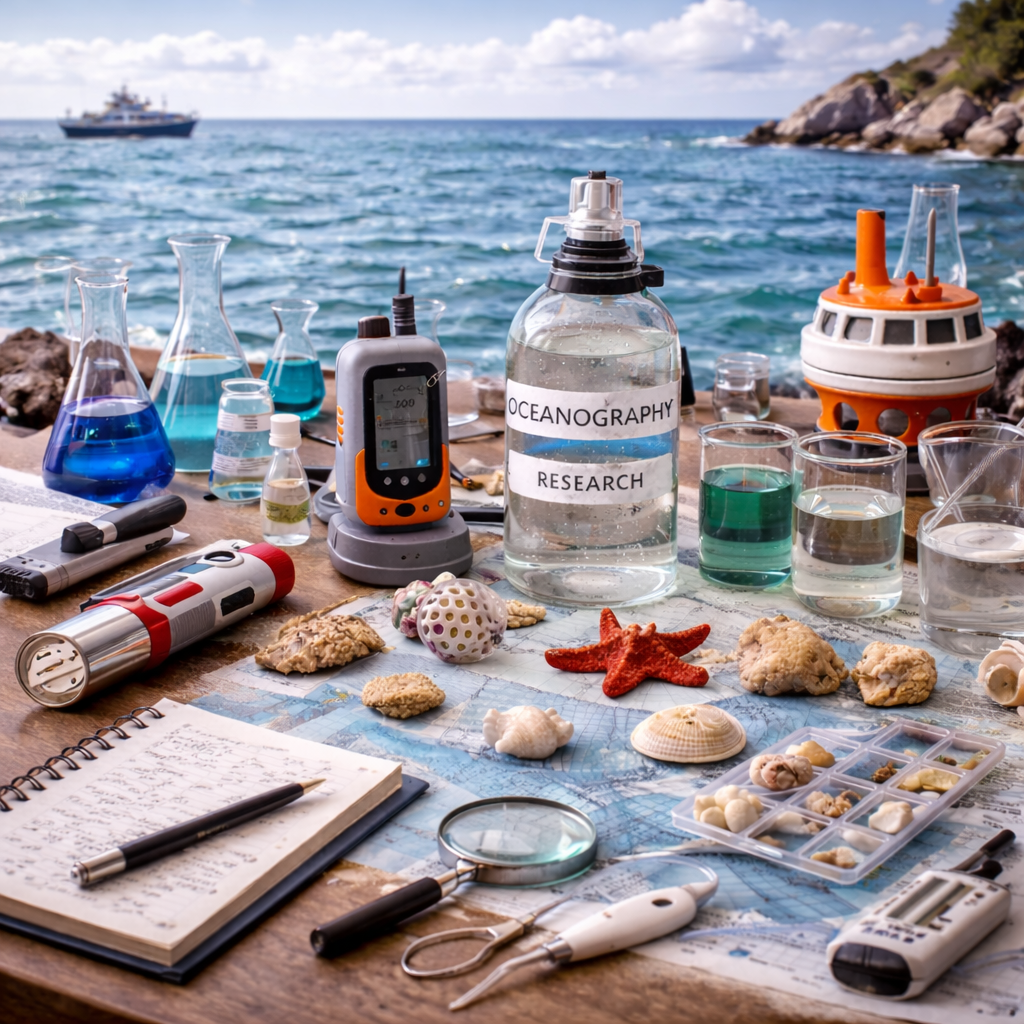
Oceanography, within Ocean & Hydrology of Earth & Environmental Sciences, is the interdisciplinary study of the physical, chemical, biological, and geological processes that structure the world’s oceans and their interactions with the atmosphere, lithosphere, and biosphere. It encompasses four major branches: Physical Oceanography, which examines ocean circulation, waves, tides, turbulence, and heat and mass transport; Chemical Oceanography, which investigates the chemical composition of seawater, nutrient dynamics, carbon cycling, and biogeochemical fluxes; Biological Oceanography, which studies marine organisms, food webs, productivity, and ecological interactions; and Geological Oceanography, which explores seafloor morphology, sedimentation, plate-boundary processes, and marine geohazards. Oceanography employs observational platforms such as satellites, research vessels, Argo floats, gliders, buoys, and autonomous underwater vehicles, along with laboratory analyses and numerical modeling, to understand how ocean processes regulate climate, support marine ecosystems, shape coastlines, and influence global environmental change. As a core Earth-system science, Oceanography informs climate prediction, fisheries management, coastal planning, environmental monitoring, and the study of planetary habitability.
Within the methodological framework of the Quantum Dictionary, Oceanography represents a domain in which terminology is deeply contextual and shaped by spatial scale, depth zone, process regime, and methodological platform. Concepts such as “stratification,” “circulation,” “upwelling,” “mixing,” or “flux” collapse into distinct semantic states depending on whether they are invoked in physical, chemical, biological, or geological oceanography, or within specialized analytical contexts such as climate modeling, biogeochemical sampling, benthic habitat mapping, or remote-sensing interpretation. Terminological nuance further arises from differences in observational modality—satellite radiometry versus in situ CTD profiling, sediment-core analysis versus water-column nutrient assays—and from dynamic environmental settings such as coastal shelves, open-ocean gyres, polar seas, or deep-ocean basins. The quantum-semantic architecture encodes each oceanographic term as a contextual semantic entity whose meaning resolves according to disciplinary lens, depth regime, measurement technique, or environmental condition. This ensures semantic interoperability with adjacent fields including climatology, geology, ecology, hydrology, environmental chemistry, and marine biology while preserving definitional precision essential for scientific modeling, prediction, and resource management. By modeling the interplay among ocean dynamics, biogeochemical cycles, marine ecosystems, and Earth-system processes, the Quantum Dictionary provides a coherent and adaptive lexicon aligned with the complex, globally significant, and interdisciplinary nature of Oceanography.