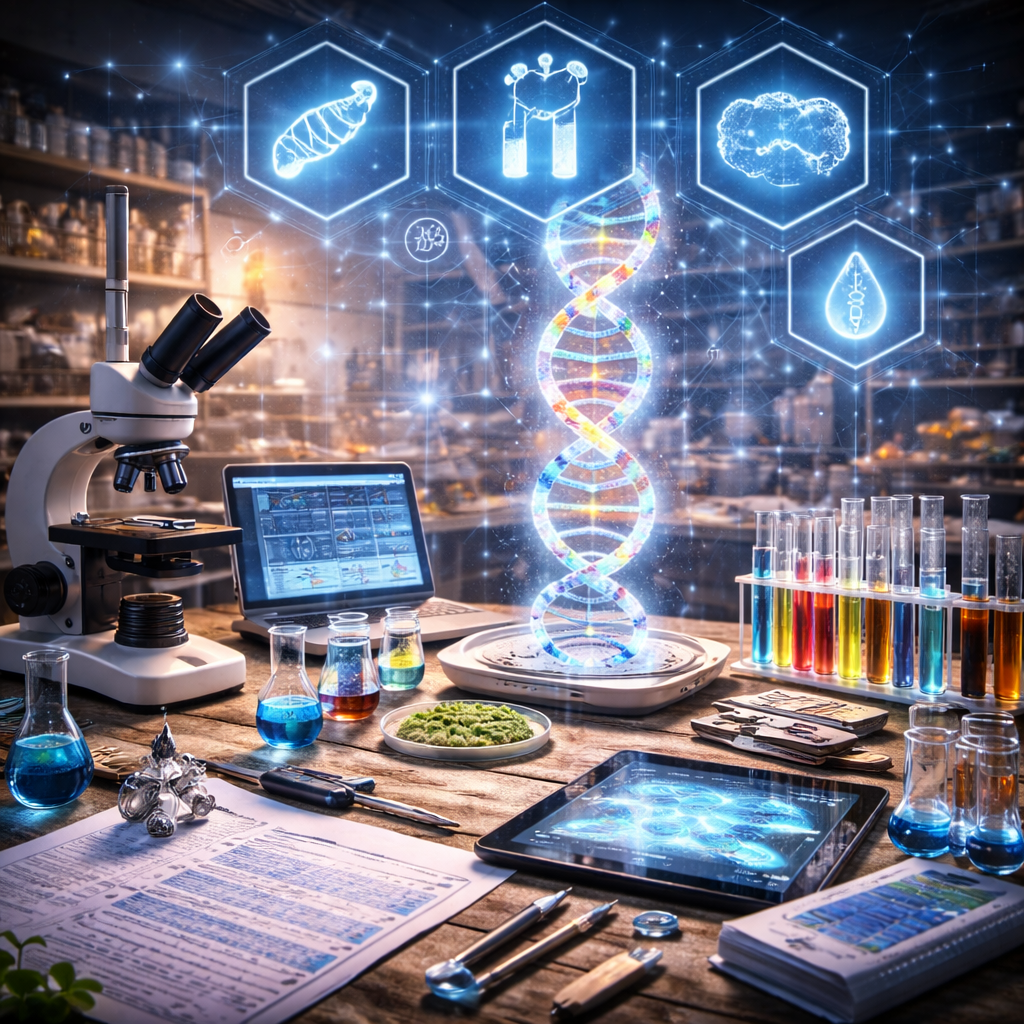
Genetics, within the Specialized Fields of Biological Sciences, is the discipline devoted to understanding heredity, gene function, variation, and the molecular and chromosomal mechanisms by which biological traits are transmitted and expressed. It encompasses classical (Mendelian) genetics, molecular genetics, population genetics, quantitative genetics, and epigenetics. Core areas of investigation include gene structure and regulation, mutation and recombination, chromosomal architecture, inheritance patterns, genetic mapping, and the mechanisms underlying phenotypic diversity. Modern genetics integrates high-throughput sequencing, genomic analysis, transcriptomics, and gene-editing technologies to elucidate the molecular basis of disease, adaptation, development, and evolution. Applications extend across medicine, agriculture, biotechnology, forensic science, and conservation biology, where genetic insights inform diagnosis, selective breeding, biological engineering, and biodiversity preservation. As a foundational life-science discipline, Genetics provides the conceptual and mechanistic framework linking molecular processes to organismal traits and population-level dynamics.
Within the methodological architecture of the Quantum Dictionary, Genetics represents a domain in which terminology is highly contextual and shaped by biological scale, methodological approach, and analytical framework. Terms such as “gene,” “allele,” “expression,” “heritability,” or “variant” collapse into distinct semantic states depending on whether they are used in classical inheritance studies, molecular regulatory analyses, quantitative genetic models, population-genetic inference, or clinical genomics. The meaning of core concepts further varies with technological platforms (e.g., sequencing, CRISPR editing, genotyping arrays), organismal systems, and interpretive paradigms such as neutral theory, selection models, or epigenetic regulation. The quantum-semantic framework encodes each genetic term as a contextual semantic entity whose meaning resolves according to methodological lens, biological context, evolutionary framework, or applied objective. This ensures semantic interoperability with adjacent fields including molecular biology, evolutionary biology, bioinformatics, biotechnology, and medical sciences, while maintaining the definitional rigor essential for research, diagnostics, and applied genetic engineering. By modeling the dynamic interplay among inheritance mechanisms, molecular regulation, evolutionary forces, and technological innovation, the Quantum Dictionary provides a coherent and adaptive lexicon aligned with the intricate and continually advancing nature of Genetics.