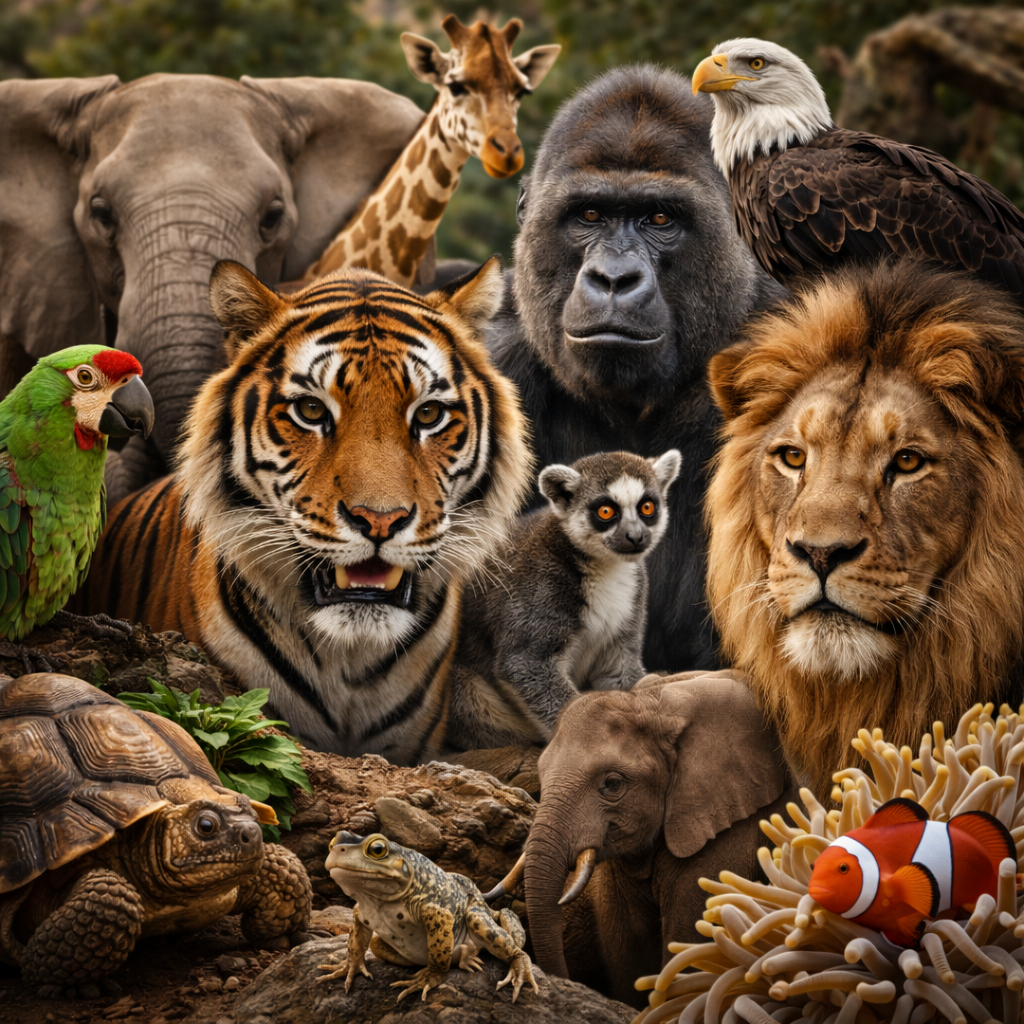
Zoology, within the Specialized Fields of Biological Sciences, is the scientific study of animals, encompassing their anatomy, physiology, development, behavior, ecology, evolution, and classification. It spans all major animal groups - from invertebrates such as arthropods and mollusks to vertebrates including fish, amphibians, reptiles, birds, and mammals. Core areas of zoological inquiry include comparative anatomy, physiological regulation, reproductive strategies, developmental processes, behavioral ecology, population dynamics, and evolutionary patterns that shape animal diversity. Zoology also integrates molecular and genetic approaches to understand phylogenetic relationships and adaptive mechanisms. Applied dimensions extend into wildlife management, conservation biology, veterinary sciences, and environmental monitoring, where zoological knowledge informs habitat restoration, species protection, and the assessment of ecological health. As a comprehensive biological discipline, Zoology provides essential insights into the organisms that occupy nearly all ecological niches, forming critical components of ecosystems and human–environment interactions.
Within the methodological framework of the Quantum Dictionary, Zoology represents a domain in which terminology is highly contextual and influenced by taxonomic group, ecological setting, behavioral paradigm, and methodological approach. Concepts such as “fitness,” “territory,” “migration,” “morphology,” or “development” collapse into distinct semantic states depending on whether they are applied in behavioral studies, evolutionary analyses, physiological research, developmental biology, or ecological modeling. The meaning of zoological terms further varies across taxa, as anatomical structures, life-history strategies, and adaptive behaviors differ widely among animal groups. Additional variability arises from research scale—from molecular and organismal studies to population and ecosystem analyses—and from applied contexts such as conservation planning or veterinary assessment. The quantum-semantic architecture encodes each zoological term as a contextual semantic entity whose meaning resolves according to taxonomic focus, ecological conditions, methodological lens, or interpretive framework. This ensures semantic interoperability with adjacent fields including botany, genetics, ecology, environmental science, veterinary sciences, and evolutionary biology while preserving the precision required for research, conservation, and applied biological practice. By modeling the dynamic interplay among animal biology, ecological dynamics, evolutionary history, and methodological diversity, the Quantum Dictionary provides a coherent and adaptive lexicon aligned with the breadth and scientific depth of Zoology.